- Free Consultation: 760-571-5500 Tap Here to Call Us









Flashing Crosswalks Along the North County San Diego Coast: A Helpful Tool, Not a Guarantee of Safety


Anyone who has strolled Carlsbad Boulevard at sunset or wandered Coast Highway 101 through Encinitas knows the pull of the view. Waves rolling in, surfers catching the last light, ocean breeze drifting across the road – it’s easy to see why so many visitors and locals alike get distracted right as they step off the curb. That same scenery that makes our coastline special is also what makes it dangerous for pedestrians trying to cross a busy roadway.
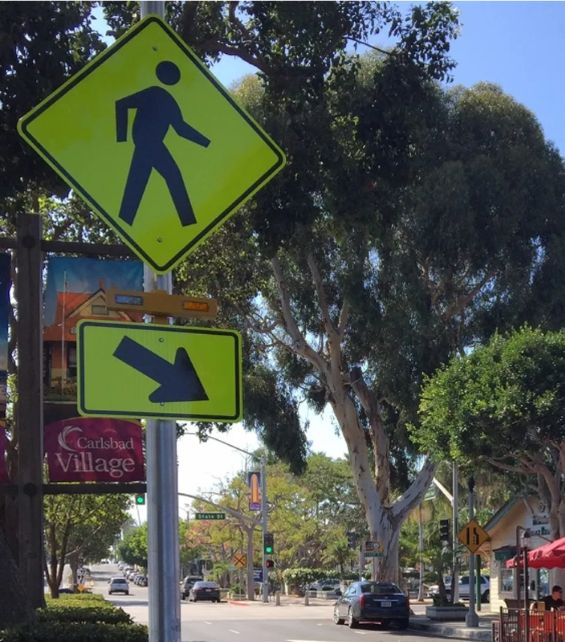
In response, Carlsbad and Encinitas have installed rectangular rapid flashing beacons (RRFBs) — the yellow, high-intensity strobe lights mounted below pedestrian crossing signs — at a number of midblock and uncontrolled crossings along the coast. Carlsbad, for example, added RRFBs at Hemlock, Cherry, Maple, and Sycamore Avenues along Carlsbad Boulevard, building on an earlier pilot beacon at Oak Avenue, and paired the beacons with pedestrian refuge medians to give people a safe place to stop halfway across the multi-lane roadway. Encinitas has pursued similar pedestrian-safety upgrades along Coast Highway 101, including enhanced crossings and, in some areas, proposals for diagonal “scramble” crossings to make it easier for people to cross the highway.
How RRFBs Are Supposed to Work
An RRFB isn’t a traffic signal. It doesn’t turn red and legally require a stop the way a signalized intersection does. Instead, a pedestrian pushes a button (or, in newer installations, is detected automatically), and the beacon flashes in an irregular, attention-grabbing pattern designed to catch a driver’s eye and remind them of their duty to yield to the person in the crosswalk. Federal research shows RRFBs are genuinely effective at this — studies cited by the Federal Highway Administration report driver yield rates increasing by as much as 98%, with pedestrian crash reductions of up to 47% at treated crossings according to the FHWA.
Those numbers are meaningful. They also mean RRFBs fail to prevent a crash a meaningful percentage of the time. And even the agencies that build them are candid about their limits: RRFBs are a warning device aimed at drivers, but pedestrians still need to watch for approaching traffic even after the beacon has been activated. A flashing light does not stop a car. Only a driver does that — and not every driver does.
A Case in Point
We recently represented a tourist who did everything right. She pushed the button at a flashing crosswalk on Carlsbad Boulevard, waited for the lights to activate, and began to cross. A driver, distracted by the same coastal views that draw millions of visitors to our shoreline every year, failed to stop in time. She suffered a fractured femur – a serious, painful injury that required surgery and months of recovery, all while she was hundreds of miles from home. Her case is a sobering reminder that flashing beacons add a layer of protection, but they are not a forcefield. They shift the odds; they don’t eliminate the risk.
Shared Duties, Shared Responsibility
California law places obligations on both sides of the crosswalk. Drivers must exercise due care for pedestrian safety, yield the right-of-way to pedestrians in marked and unmarked crosswalks, and reduce speed when needed — flashing beacon or not. Pedestrians, in turn, have a duty to exercise reasonable care for their own safety: making eye contact with drivers when possible, confirming that approaching vehicles are actually slowing down, and never assuming that a flashing light guarantees a stop. Neither duty cancels out the other. When a driver runs a beacon-activated crossing, that driver can be held liable — but pedestrians and their attorneys still need to document that reasonable care was used, especially in a case involving a visitor unfamiliar with the local roadway.
If You’ve Been Hurt in a Coastal Crosswalk
Carlsbad Boulevard and Coast Highway 101 are beautiful roads, but their popularity with pedestrians, cyclists, and distracted drivers has made them some of the higher-risk corridors in North County San Diego. If you or a loved one has been injured in a crosswalk — flashing beacon or not — you need attorneys who know these specific intersections, understand how RRFB systems are supposed to function, and know how to build a case against a driver who failed to yield.
North County Injury Lawyers was voted Best Personal Injury Law Firm in North County San Diego, and our team has fought for pedestrians, cyclists, and crash victims across Carlsbad, Encinitas, and the surrounding coastal communities for years. We offer free consultations and work on a contingency basis, so you pay nothing unless we recover compensation for you. If a driver’s inattention left you injured on our coastline, call North County Injury Lawyers today to discuss your case.